The problem
institutional painting commissions involve many stakeholders and zero room for disruption — clients need a single accountable office, not a crew turning up to paint.
Our approach
Project Management Office
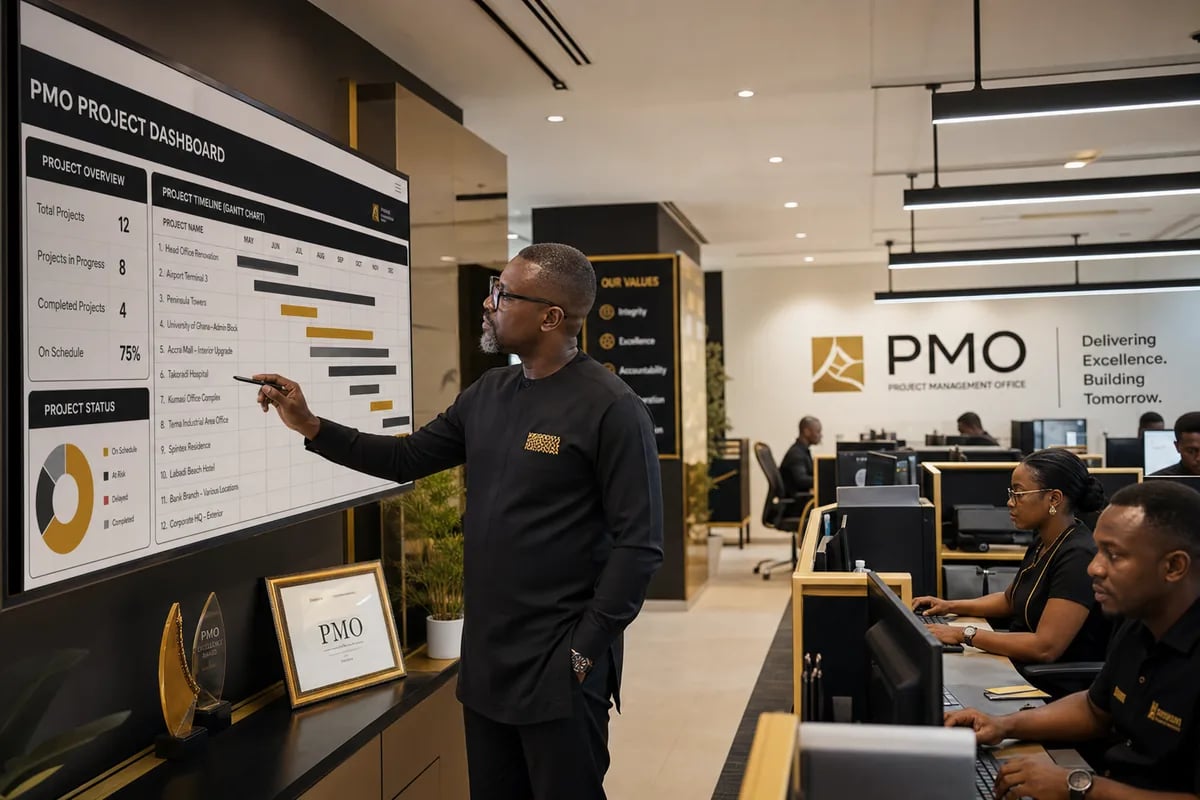
The Corporate Painters project-management-office model — one accountable office coordinating specification, scheduling, stakeholders, QC, and handover so a corporate commission runs as a managed programme.
The Challenge
A corporate painting commission is rarely just painting. It involves an architect’s finishes schedule, a facility manager’s operational constraints, a procurement team’s contract terms, a security or access regime, brand custodians, and an occupied building that cannot stop working. When those threads are managed informally — a foreman fielding instructions from whoever is on site — the result is missed dependencies, change requests that nobody owns, trading or operations disrupted, and a handover that satisfies no one.
A institutional client cannot run a commission that way. They need a single accountable point that holds the specification, the schedule, the stakeholders, and the quality record together — and answers for all of it — rather than a crew that turns up to paint and improvises around problems as they appear.
The Corporate Painters Solution
Corporate Painters runs corporate commissions through a project management office, not a foreman. A named project lead owns the engagement end to end: translating the specification and the architect’s schedule into a works plan; sequencing the work around the building’s operations so trading, reception, and occupied floors are never disrupted; coordinating the architect, facility manager, procurement, security, and brand custodians as one programme; and holding the QC and documentation record through to handover.
That office is the client’s single point of accountability. Dependencies are tracked rather than discovered, change requests are logged and priced against the specification rather than argued on site, and progress and quality are reported against plan. The painting itself is delivered by skilled crews — but it is delivered inside a managed programme, which is what separates an institutional corporate commission from a decorating job.
Documentation & Process Specification
The project office produces the spine of records a corporate client expects: a works plan and sequence tied to the specification and the architect’s schedule; a stakeholder and responsibility map; a change-control log pricing and recording every variation against the spec; stage QC sign-offs to the inspection regime; and a structured handover pack at completion. Surface preparation is graded to ISO 8501 and dry-film thickness verified to ISO 2808 within that record, so the office hands over evidence, not assurances. The client receives one coherent project file rather than fragments from a crew.
Typical Engagement Profile
The project-office model is how Corporate Painters delivers its larger and more complex commissions — multinational HQ fit-outs, bank programmes, and multi-property estates — where stakeholder coordination and operational continuity matter as much as the finish. The office scales from a single high-stakes interior to a multi-site programme under one specification and reporting framework, run from the project office that has managed corporate-grade painting in Accra since 1990.
Outcomes
- A single accountable office owning specification, schedule, stakeholders, and QC
- Work sequenced so trading, reception, and occupied floors are never disrupted
- Variations logged and priced against the specification, not argued on site
- One coherent project file and structured handover, not fragments from a crew